


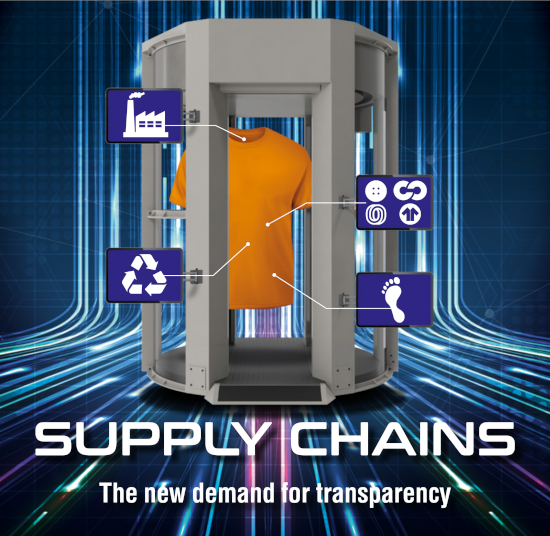
The times when products came from who-knows-where and nobody asked any questions are long gone. Transparency is the order of the day. Whilst consumers want to know more and more precisely what they are buying and consuming, new EU laws are obliging all players along the value chain to check their suppliers and make them transparent – with far-reaching consequences for the haptic advertising market. eppi magazine spoke with end users, distributors and suppliers.
Who can honestly say they have never got worked up after ordering a product from Amazon and it hasn’t arrived after two days yet? Or because one’s favourite jeans are out of stock at the local store? In an era when everything always seems to be available everywhere, one often doesn’t spare a thought about how highly-complex and entangled global supply networks are. At the same time, the consumers are becoming more critical and often carefully inspect the products they receive and where they originate from. That is not necessarily contradictory, but it does present all those people involved in the supply network with a big challenge – not only in the case of the favourite jeans in question, but also with regards to merchandising and haptic advertising.
Manuel Abraas, CEO of the sea protection organisation, Sea Shepherd Germany, has plenty to say on this topic: “As an NGO we have very critical supporters. Quite rightly, they expect one hundred percent circumspection particularly in the merchandise section. Unfortunately, the textile industry is very harmful for the environment and for the people who work in it.” But even for brands, whose target group perhaps don’t look into the origins of the products that closely, transparency is becoming increasingly important, partly because of the legal requirements, partly because of the company’s sustainability strategy, partly through the decision-makers’ own accord. “The theme only plays a minor role among the fans. Accordingly, the measures we take are more intrinsically motivated,” reported Martin Schittko, Director Merchandising at the Champions League participant, Eintracht Frankfurt.
If one is to believe Abraas, there is “a lot of room for improvement regarding quality and above all sustainability, particularly in the merchandise segment. For smaller companies or NGOs, like us, the road to maximum transparency is only possible in cooperation with companies that are at home in the textile branch and who have recognised the signs of the times.” Schittko also obliges his subcontractors to report. “We demand the corresponding evidence and document it. There are minimum criteria for our own demands, which we have laid down for certain product categories and which have to be complied with during production.”
On the sensitive topic of textiles, Sea Shepherd works together with the specialists, Brands Fashion. “The entire supply chain from the cotton field, to the dyeing plant, through to the last manufacturer is depicted by Brands Fashion,” explained Abraas. “Information is provided on the factory, the number of employees and the production steps, but also photos and videos, as well as certificates, references on recycling and article information are provided.”
Among others, Brands Fashion supplies merchandise and fan item programmes for several German league football clubs and has been working on making its value chain as transparent as possible for years, obligating the producers accordingly.
Rabea Schafrick, Head of Sustainability at Brands Fashion, reported: “Transparency in global supply chains demands a host of measures – including the development of long-term partnerships, regular personal visits on-site as well as nurturing direct relationships also to the upstream supply chain. Certifications like GOTS or GRS can also contribute towards traceability. In addition to this, in practice self-declarations by the production partners, physical tracking methods as well as digital transparency tools are often implemented. For instance, since 2017 we have been using our own tool Tracycle to depict complex textile supply chains digitally and make them transparent.”
Furthermore, Brands Fashion has been organising delegation trips to India for many years under the project name: “From the field to the fan shop”, so that contractors from the football business can inform themselves on-site about ecological cotton cultivation and the textile production in the partner factories. “Many consumers underestimate how time-consuming and resource-intensive it is to produce a garment,” reported Schafrick. “New perspectives emerge on-site. Our customers often report about ‘eye-opening experiences’. For us this is an effective tool for sensitising clients and for the credible conveyance of sustainability.”
Secrets are a thing of the past
That companies disclose their procurement sources this liberally and even take customers to visit them, would have been inconceivable two decades ago. The days of secrecy are however long gone as Joy Puor, ESG Director at the Dutch import company, xd connects, emphasises: “The old idea of shielding information from customers or competitors is becoming outdated. Transparency serves a purpose and in our interconnected world concealing certain data only creates suspicion.“
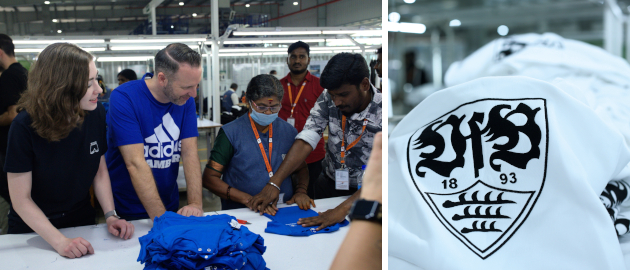
Together with German league football clubs, a team from Brands Fashion travelled to India at the beginning of the year in the scope of the initiative “From the field to the fan shop”. Here the contractors were able to inform themselves about ecological cotton cultivation and the production in the factories.
Many suppliers have long since internalised this and work closely together with their partners, the distributors and their customers. “Transparency is essential – both to meet rising expectations and to future-proof our industry,” according to Anne Karine Lemstra, VP of Sustainable Development at the globally operating full-range stockist, PF Concept. “As a committed amfori BSCI member, we apply our Code of Conduct and rely on both our own and third-party audits. Certifications like GRS, OEKO-TEX®, FSC® and ISO 14001 help us validate our claims and ensure credible compliance. We also invest in detailed supply chain mapping. And this, according to Lemstra, even beyond the first-tier suppliers, in order to recognise risks.
These measures must be understood – as is actually true of all processes in the sustainability section – as “work in progress”. Virginia Yanquilevich, CEO of the Dutch drinkware specialist, Dopper, explained: “You don’t need to have everything figured out, but you do need to be open and willing to share. Transparency means tracking more than just CO2. Companies should report on total footprint – including product and company emissions, logistics and supply chain impact. Sharing details like the producers involved and the country of production adds another layer of accountability.”
And it is also important to be open here too and not try to use every legal loophole as Schittko said. “We always state that country as the country of production, in which the majority of the product’s manufacturing took place. As far as we are concerned, a T-shirt that is produced in India and subsequently embellished with a screen print in Germany is still ‘made in India’ and only ‘printed in Germany’.”
In the jungle of abbreviations
And all of this is becoming an obligation from a legal point of view. Over the past years, a whole series of EU regulations have been passed, which are about to come into force and which will change the global value chains sustainably, in both senses of the word. Abbreviations like CSDDD, ESPR or DPP already sound complicated, and implementing the directives is indeed tricky.
The new EU supply chain guideline, the Corporate Sustainability Due Diligence Directive (CSDDD), aims to make companies commit to respecting human rights and environmental protection within their own area of business and along the entire value chain. It comes into force gradually from 2027 onwards and initially only affects companies with over 5,000 employees, from 2028 companies with more than 3,000 employees and from 2029 onwards companies with more than 1,000 employees. The companies have to check their entire “chain of activities”, including upstream and downstream business partners, i.e. all business partners on the supplier side, who are connected to the products manufactured or services provided by the company. This also fundamentally includes all business partners, who transport, distribute or store products for the company.
This trickle-down effect thus indirectly impacts all partners that supply a company that the CSDDD applies for with merchandise or promotional products. Valeria Bortoletto is Sustainability Manager – both at the multinational promotional products agency, Zinc Group, as well as for the Ippag (International Partnership für Premiums and Gifts) cooperative – she believes this will have far-reaching consequences for the industry: “We are deeply embedded in the supply chains of the large corporates. So, while the CSDDD might apply directly to only a few thousand companies in Europe, the pressure to comply will cascade down to everyone doing business with them. That includes us.”
Demands that the intermediary distributors are also passing on to the suppliers, as Lemstra confirmed: “Even if we’re not directly in scope, the impact is real. Many of our end user clients – especially multinationals – are subject to the CSDDD and will need reliable data from their suppliers to comply. So, we are already being asked for detailed transparency on topics like human rights, labour conditions and environmental performance.”
Although the industry is already well-prepared for such issues, the challenge lies in keeping up with the many regulations and requirements, particularly for smaller players.
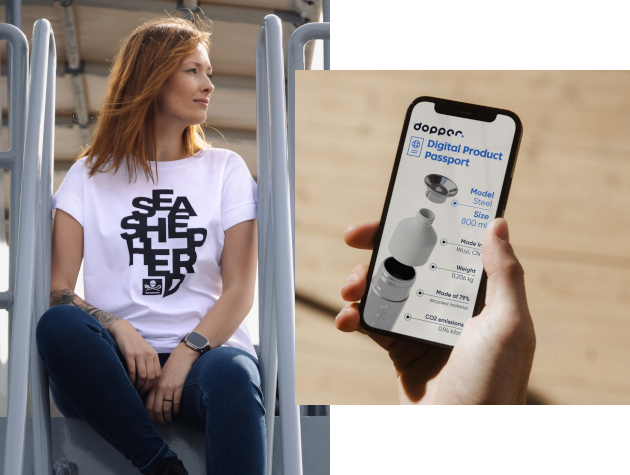
Sea Shepherd bets on certificates like GOTS and Cradle to Cradle™, Dopper introduced a digital product passport in 2024, which allows i.e. CO₂ emissions and the water consumption as well as information on care, repairs and recycling to be called up.
Product passport, please
The EU’s new Ecodesign Directive, the ESPR (Ecodesign for Sustainable Products Regulation), presents even more immediate consequences than the CSDDD for all those placing products on the market in the European Economic Area. This applies for almost all products and sets binding requirements for 16 product aspects – including among others functional reliability, retrofittability, maintenance and repair, energy, water and resource efficiency as well as recycled content. Its goal: To improve the overall and broader sustainability of the products that are in circulation on the European Single Market. However, this will involve a great deal of effort by those placing the products onto the market, as Lemstra estimated: “ESPR is raising the bar significantly. The level of data granularity now expected is a challenge. It may lead to more documentation and audits. Scaling this across our entire assortment is not easy, but it is a necessary step – and one we are ready for.”
A key element of ESPR is the digital product passport, DPP for short. The aim of the document is to make facts about every product’s production location, resource consumption, lifecycle or CO2 footprint directly available via a link, QR code or similar. This will become mandatory from 2027. Hence, time is pressing, which is why the promotional products suppliers have long since been working on compliant solutions.
Dopper already introduced a digital product passport in April 2024, which allows inter alia CO2 emissions and the water consumption as well as information on care, repairs and recycling to be called up. “Our current digital product passport focuses on the cradle-to-gate phase, but we are extending it to include end-of-life information,” reported Yanquilevich. “This will cover which spare parts are available, how to extend the lifespan of the product and clear guidance on how and where to recycle each component.”
Extensive product information is also standard procedure at PF Concept. The entire data of hundreds of products is centralised in a product information management system, which encompasses the material, weight, origin, certifications and more. The necessary enhancements are in the pipeline: “After the summer, we will launch a new product sheet for every item on our store – essentially a product passport,” explained Lemstra. “These sheets will include detailed info on product and packaging materials, recycled content, weights and certifications.”
Both PF Concept and xd connects additionally use the digital tracing tool, AwareTM, for parts of their textile collection. A digital tracer is integrated into the product to make the origin and further processing of every single item transparent. Production data that is recorded by every supplier in a blockchain generates a digital twin and a virtual flow that follows the physical material flow. Scanning the item using a handheld scanner enables the entire value chain to be checked immediately. “The platform and technology behind it is meant to track materials from yarn to end product throughout the supply chain,” explained Puor.
It’s all about the data
As sophisticated as the digital platforms the distributors use may be – they can only be as good as the data they are fed with. “Getting the digital structure into place is manageable,” according to Bortoletto. “The real issue is data quality and traceability, especially beyond tier 1.”
“The actual challenge lies with the data that others input that ends up in ‘our’ DPP,” added Puor. “This not only applies for tier 2 and further, but even for tier 1 suppliers. After all, suppliers outside the EU do not necessarily have to comply with EU legislation.”
This is why one of the market’s main criticisms of EU legislation is that it doesn’t take the complexity of global delivery networks into account. Since ultimately, the producers in the manufacturing countries cooperate with a number of upstream suppliers, who in turn themselves procure products and raw materials from other sources. Many manufacturers are thus not able to provide seamless proof. “Some suppliers, especially those already certified, are well prepared and see this as a competitive advantage,” Lemstra noted. “But not all have the resources – many are smaller businesses without compliance teams. We spend a lot of time training both our Global Buying Services team in Asia and our suppliers. Ultimately, strong supplier relationships are crucial – because they also need to push these requirements further down the chain.”
“We often deal with factories that may not have robust data systems or the resources to gather information about where their raw materials come from,” added Bortoletto. “In many cases, even the suppliers themselves don’t know what is happening beyond their immediate partners. We are trying to solve this by engaging our supply partners in the journey. We don’t expect small suppliers to become tech companies, but we are supporting them with clear data templates, predefined material categories and simplified certification pathways.”
Overall, it is a mammoth task when you consider how extensive the data set is that the ESPR is demanding as part of the DPP. “The DPP could be an amazing tool for traceability and storytelling, but if every low-cost item needs a unique QR code tied to more than 20 data points, the cost and complexity could outweigh the benefits,” complained Bortoletto. “Another big area is harmonisation. Right now, companies are expected to comply with CSRD, CSDDD, ESPR, EUDR, each with their own formats, timeframes, and data requirements. If the European Commission could align these more clearly and encourage interoperable platforms, it would save massive administrative effort.”
Bureaucratic obstacles
The main point of criticism voiced by many market participants regarding the many new regulations is the huge bureaucratic effort they entail.
“Some of the guidelines feel disconnected from real supply chain complexities. The admin burden can be very high and I worry that we are spending more time on data collection than on making actual improvements. We need frameworks that drive action – not just reporting,” Lemstra stated. He feels this particularly applies for small companies: “Many companies want to do better, but everyone is struggling with resources. Especially for SMEs and smaller suppliers, the level of proof required is overwhelming.”
Schittko from Eintracht Frankfurt also regrets the fact that “providing proof is often given greater priority than achieving concrete product standards and quality standards. The time spent on reporting and providing evidence could without doubt be more meaningfully invested in improving the sustainability of the products. In this respect, our small merchandising area in particular is faced with several challenges.”
What could help: greater efficiency and clarity regarding the formats, timeframes, and requirements of the individual regulations. Clear guidelines that precisely specify which information is required and how detailed it should be, as well as a greater degree of harmonisation among the guidelines, would minimize unnecessary effort and duplicate reporting.
Especially since some of the stipulations don’t consider the peculiarities of the promotional products industry: “The promotional products sector is incredibly diverse: We work with a huge variety of products, often in small volumes and with short lead times,” Bortoletto reported. “Asking for full lifecycle data or origin tracing for a low-value branded give-away might make sense in theory, but becomes unfeasible in practice. We need a more tiered approach, where expectations are proportionate to the product’s risk and materiality.”
Competitive advantages
At least there is a positive side-effect: Because companies in the B2B area are forced to comply with new directives much more meticulously than consumer brands, a benchmark is frequently set – also for B2C companies. “The B2C market has made some incredible progress, particularly in the fashion and electronics segments. Many brands are now offering full transparency down to farm or factory level,” informed Bortoletto. “But B2B also has strengths, like more rigorous supplier onboarding processes, consistent procurement standards and now, due diligence requirements that sometimes go beyond what B2C is doing.” According to Puor, this is among others due to the fact that the pressure to comply is much higher in B2B industries: “Companies in B2B need to comply with legislation and provide supporting evidence. And if they can’t comply or provide transparency, they might lose a customer – which usually represents a much larger value than a retail brand losing one consumer that asks critical questions.“
“Companies that haven’t committed so far, will have to realign themselves in the future and in our opinion, this is long overdue,” added Schafrick. “On the other hand, those who position themselves well early on, will secure themselves a clear competitive edge.”
Yanquilevich also sees the “chance to lead. We already offer more transparency than most and this allows our customers to make better, more sustainable decisions. Being ready now gives us an edge.”
“These new requirements are not just a compliance burden, they are a strategic opportunity,” added Bortoletto. “For us, they help differentiate the Zinc Group and IPPAG members as leaders in transparent, responsible sourcing. We are developing a structure that gives clients visibility over product impact, ethical sourcing and circularity. That is a huge value-add in today’s market.” And this also with regards to the customer’s business, as Bortoletto continued: “These tools allow them to reduce risk, meet internal ESG goals and align their merchandise strategy with broader sustainability objectives. They can report with confidence and defend their purchasing choices.”
In the long run, many marketing participants agree that the new directives will indeed lead to more sustainable products and practices – and thus also to the future sustainability of haptic advertising and merchandise. “These changes are tough, but they bring real opportunities,” said Lemstra. “We deal in gifts and one of the 10 Rs of circularity is ‘refuse’ – something we want to avoid. We must stay relevant and that means becoming more sustainable.”
Because at the end of the day, the person, who is at the end of the supply chain, makes the decisions. The more detailed the information about the DNA of the products the decision-makers are provided with the better – for their own reporting and for that of the supplier. And those who know how complex the entire matter is, are more patient when things don’t always run smoothly. // Till Barth
Illustration: Thomas Gebhard, © WA Media; photos: Brands Fashion (2); Dopper (1); Sea Shepherd Deutschland (1);
