




In professional football, special edition jerseys are no longer just an add-on product, they have evolved into a strategic branding tool. However, the balancing act between emotional fan engagement, fashionable lifestyle products and commercial interests frequently pose the question as to how many special editions can clubs expect their fans to accept without losing credibility.
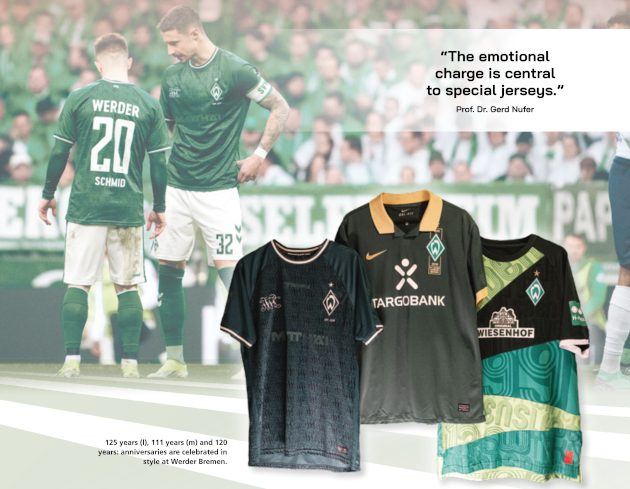
Generally, as a club’s fan you want more than just your team to play well and win – you also want to show others which club your heart beats for. Sport and merchandising are thus inseparably
linked. Clubs generate income through ticketsales, prize-money from competitions or revenue from television broadcasts. Merchandising is a further source of income that certainly shouldn’t
be underestimated. The economic potential of fan items, jerseys in particular, was impressively demonstrated in the year 2018, when Cristiano Ronaldo transferred from Real Madrid to the Italian recordholding champions, Juventus Turin. 500,000 jerseys bearing his name and the iconic number 7 were allegedly sold within the first twelve hours. Even if this figure is considered to be unrealistic, priced at around 100 Euros each, even the realistically estimated approx. 300,000 Ronaldo kits sold by the end of 2018 would still represent a huge turnover volume of 30 million Euros.
It is therefore no surprise that the highly-commercialised football clubs of Europe’s professional leagues are also casting their eyes on the jersey market in their hunt for new sources of income. And so, in addition to the obligatory new home, away and alternate third kit released each season, a further product is increasingly coming under focus: the special edition jersey.
Rastafari, Carnival and coal
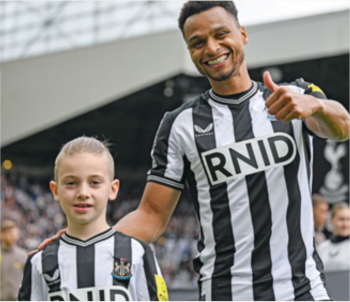
As part of the “Unsilence The Crowd” campaign, deaf Newcastle United fans can physical feel the atmosphere of a football match at St James’ Park for the first time thanks to the special “Soundshirt” jersey. It transmits sound waves to the wearer’s body, allowing them to physically feel the atmosphere of the match.
Hardly any professional club does without special edition shirts nowadays. Ajax Amsterdam, for instance, brought out a shirt based on the Bob Marley song, Three Little Birds, which the fans of the Dutch capital’s club often sing. Styled in the colours of the Rastafari movement, the jersey underlines the close connection between the club and the fans or rather their fan culture. Newcastle United even presented a technical revolution in the form of a special edition kit a few years ago. Together with the outfitter Sela, Newcastle was the first club to develop a jersey for hearing-impaired football fans. The shirts can convert the noise in the stadiums into vibrations, which can be perceived on the skin.
There are also numerous examples of special editions in the German Bundesliga. 1. FC Köln regularly releases special jerseys for the Carnival season, Fortuna Düsseldorf brought out a special kit to commemorate their former sponsoring of the band, Die Toten Hosen, and Borussia Dortmund presented an all-black kit in homage of the city’s coal and steel background. According to Peter Rohlmann, publisher of the annual fan item barometer and of the survey “Special edition kits as sport merchandising boosters”, this development was significantly triggered in Germany by a decision taken by the German Football League in the year 2007: “Since 2007 in addition to the three prescribed kits per season, the DFL allows the clubs to offer one further jersey.” The ever-increasing size of the outfitting contracts is another, possibly even more decisive factor here. “When the financial demands of the clubs on the sports equipment manufacturers rise, they in turn try to strengthen their own brand using additional impulses such as an extra jersey,” stated Rohlmann.
Between turnover and brand impact
Jerseys do indeed make up a considerable part of the merchandising turnover of a club, however comparably special edition kits only account for a small share within this segment. Their actual value lies in their symbolic significance. As a rule, special editions convey brand identity, pick up on club anniversaries, local history or cultural themes, strategically linking these to the club’s identity. This clearly distinguishes them from classic merchandising items.
“In the case of special edition jerseys, the emotional charging is paramount. Whereas classic merchandising products primarily serve an existing demand, if strategically implemented special edition kits can generate demand. They are emotionally charged through the connection to the club’s identity and create a bond,” explained Prof. Dr. Gerd Nufer, Director of the German Institute for Sports Marketing. At the same time, according to Nufer, special edition jerseys are not an isolated tool, but firmly anchored in marketing: “They are part of the overall marketing mix. They touch upon all four Ps (Price, Place, Promotion, Product): an ideally limited product, a premium price, a well-founded communication with a clear story and distribution that conveys exclusivity. If special edition jerseys are implemented strategically they can activate specific target groups.”
The rarity factor comes on top. Special edition kits are usually highly limited and thus become coveted collectors’ items. “If Fortuna Düsseldorf limits a special edition kit commemorating the founding year down to 1,895 pieces, the club can often announce that it is ‘sold out’ within a short space of time and thus position its own brand as particularly desirable,” Rohlmann explained. Alongside the classic fans, special edition jerseys are increasingly attracting new target groups, for whom design and everyday wearability are more important than club affiliation.
Special edition kits are thus evolving from being pure fan items into fashionable lifestyle products: “For a long time sport merchandising predominantly addressed existing fans. However, special edition kits are now demonstrating that the focus has shifted. Many current designs that are intentionally produced for everyday suitability aim to extend the target groups,” explained Nufer. Furthermore limited editions attract buyers, who see a potential resale value in the jerseys. They store the shirts unworn and still in the original packaging, only to resell them later at a higher price.
Global markets
What can be observed in the Bundesliga regarding brand management and target group expansion, is also happening in the best league in the world: the Premier League. There is more money involved in English football than in any other league. This is last, but not least due to the fact that many of the top clubs belong to individual entrepreneurs, corporate groups or even states. Where the most capital is, is where the best players can be found as well as also global attention that goes far beyond merely visiting the local stadium.
Against this backdrop it is hardly surprising that special edition kits are particularly implemented in the Premier League. The prime intention is not for them to reach the local stadium-goer, they are clearly aimed at an international audience. The focus doesn’t lie as much on the local fan, who spontaneously decides to watch an FC Chelsea game at Stamford Bridge, but instead on the fans in global markets, who mainly experience the club via (social) media and merchandising.
In this context, special edition jerseys above all serve as a visual differentiation tool in a highly competitive, international market. They are part of a globally oriented brand strategy that the Premier League clubs are using to expand their reach and address new target groups, totally regardless of the match day and independent from the classic stadium experience. The function of the jersey is thus also experiencing a shift: from the traditional identification symbol for existing fans to a globally marketable product that is not dependent on the match day.
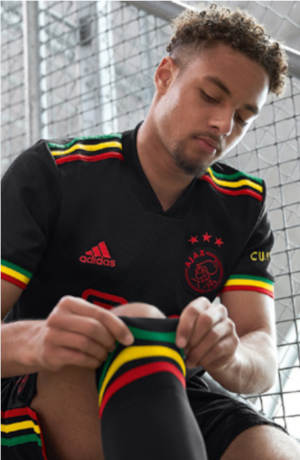
Ajax Amsterdam brought out a jersey based on the Bob Marley song, Three Little Birds, which the club’s fans often sing. Styled in the colours of the Rastafari movement, the jersey underlines the close connection between the club and its fan culture.
Taking a look at top international clubs, it becomes clear that this logic is not applied with the same level of caution everywhere. A prominent example is FC Barcelona, which uses special edition kits even more extensively as targeted marketing tools. Following the Ballon d’Or award ceremony, where Aitana Bonmatí won the women’s Ballon d’Or and the rising star, Lamine Yamal, claimed second place, the Catalonian club released two own special edition kits. The player’s name and number were printed on both shirts in an individually designed, golden font. However, fans of the Catalonian team had to dig deep into their pockets. Whereas the club’s regular home jersey already costs 134.99 Euros, the Ballon-d’Or special edition jersey went on sale for 299.99 Euros. The kit is thus positioned more as an exclusive premium and collector’s item rather than a classic fan item.
Beyond this, FC Barcelona increasingly employs special edition shirts as a platform for global brand cooperations. Since Spotify became the club’s main sponsor, there is a so-called “Jersey take-over” every year during the classic match against Real Madrid. Instead of the sponsor’s logo, internationally well-known music acts are illustrated on the jersey. For example, the artwork of Ed Sheeran’s album called Play decorated the kits of the Catalonian club in 2025; previous to that, among others, The Rolling Stones were represented by their iconic tongue.
The danger of oversaturation
The increased importance of special edition jerseys means the clubs bear greater responsibility in implementing this tool. Because special edition shirts are no longer merely design or revenue-related decisions, they actually represent an expression of club identity. A lack of connection to the club or its fan culture can quickly become a problem. “The sports merchandising market has changed drastically. We no longer find ourselves in the gold-diggers’ phase, but in a differentiated and mature market. The fans have become more critical and expect to have a say in the matter,” Gerd Nufer emphasised.
However great the promotional effect and emotional appeal of special edition shirts may be, they also bring risks with them. The unique impact of special edition kits can be lost if they are implemented too often. “Special edition jerseys can quickly become excessive. It becomes problematic if the fans get the impression that the occasions are contrived or if every game is portrayed to be a special event,” Nufer warns. Peter Rohlmann also sees the risk of fan fatigue: “If a further special edition jersey is released every season, the perceived exclusivity not only suffers, so does the already heavily strained fan budget.”
It is therefore increasingly discussed how many special editions a brand can sustain long-term without damaging its image. Especially in globally-oriented leagues such as the Premier League, it is becoming clear that although special edition jerseys attract short-term attention, their impact diminishes as soon they become routine. Once special editions become expected, there is not only a risk of fan fatigue, but also of a gradual devaluation of the brand.
In other sports, the approach to special edition jerseys is in some cases much more institutionalised. The North American basketball league, the NBA, is a frequently cited reference point, where special edition shirts have been an integral part of the league structure for several years. In the scope of the so-called City Edition, each team has created one own special edition per season since the 2017/18 season, which is specifically designed to reflect local identity, the history of the city or cultural references.
In contrast to many European football leagues, the special editions are not the result of event-related individual decisions of the clubs, but instead a clearly defined, annually recurring format. All the teams are outfitted by the same supplier, there is freedom of design within a defined framework. The special edition jerseys are therefore neither a surprise, nor an end in themselves, but part of a controlled system with clear fan expectations.
Many observers believe this very structure is the reason why special edition jerseys in the NBA are not perceived as becoming excessive, despite their regularity. The special status results more from the clear limitation and plausible content-related logic rather than from the uniqueness.
The situation in the NBA shows that the implementation of special edition shirts does not necessarily have to lead to oversaturation among the fans – provided that a club establishes clear structures for the implementation of these special editions. One thing is clear: Special edition jerseys are not a sure-fire success, but a sensitive brand tool that requires strategic finesse. It is a constant balancing act between the desire for innovation, commercial interests and responsibility towards an increasingly critical, globally connected fan base. //MG