



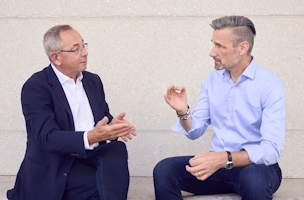
Uwe Munzinger (l) and Olaf Hartmann
D – The Markenkraft project, under which Olaf Hartmann and Uwe Munzinger conduct research and consulting on brand experience, strategy and multisensory brand coding, has presented a new Brand Experience Survey in cooperation with neuroflash, which describes itself as a leading AI audience intelligence platform in Europe. For the first time, 112 of Germany’s most heavily advertised brands were evaluated across four generations using digital twins regarding brand experience quality, preference and brand trust. This new methodology opens up new possibilities for brand managers, as the digital twin methodology delivers reliable insights for each brand, target group and category in near real-time. Neuroflash’s digital twins are AI-powered representations of real people, based on survey data from over one million individuals. They provided 22,375 individual verdicts for the study, broken down by brand, generation and category. Practical testing showed that the digital twins’ verdicts reproduced classic market research results with high precision (r=0.856), while requiring only a fraction of the time and cost of traditional tracking studies.
Based on the example telecommunications, the study clearly demonstrates that advertising volume does not create preference alone. While 1&1 (around 204 million Euros in advertising spending) and Vodafone (around 297 million Euros) achieved only weak scores in terms of trust and preference despite high expenditures, Congstar had a more convincing impact with a budget of only 122 million Euros.
According to the study, dm delivers the best brand experience in Germany, scoring 79/100. Lindt comes in second place with 77, with Bild (24), Temu (28) and Deutsche Bahn (29) bringing up the rear. A clear generational divide also became apparent. While Audi scores 72 among Baby Boomers, it only attained a score of 33 among Gen Z. The gap is similarly wide for Knorr, with 36 to 73, which the authors of the study consider to be a warning sign.
The NAWI index from Munzinger and Hartmann’s BX Navigator model, which correlates highly with the measured brand preference (r = 0.80), confirms that what really drives brand preferences is a brand experience that is useful, different, consistent, and interesting,
“The Markenkraft Brand Experience Survey offers a quick introduction into a deeper understanding of the success factors of brand experience. It provides brand managers with easy access to critical knowledge,” stated Uwe Munzinger of Markenkraft.
Dr. Jonathan Mall of neuroflash reviewed the study positively: “Digital twins are changing how quickly and deeply we can measure brand perception. Instead of waiting weeks for a panel, we get reliable data with a validity that is on a par with market research using real participants.”